• Posted on October 13, 2025
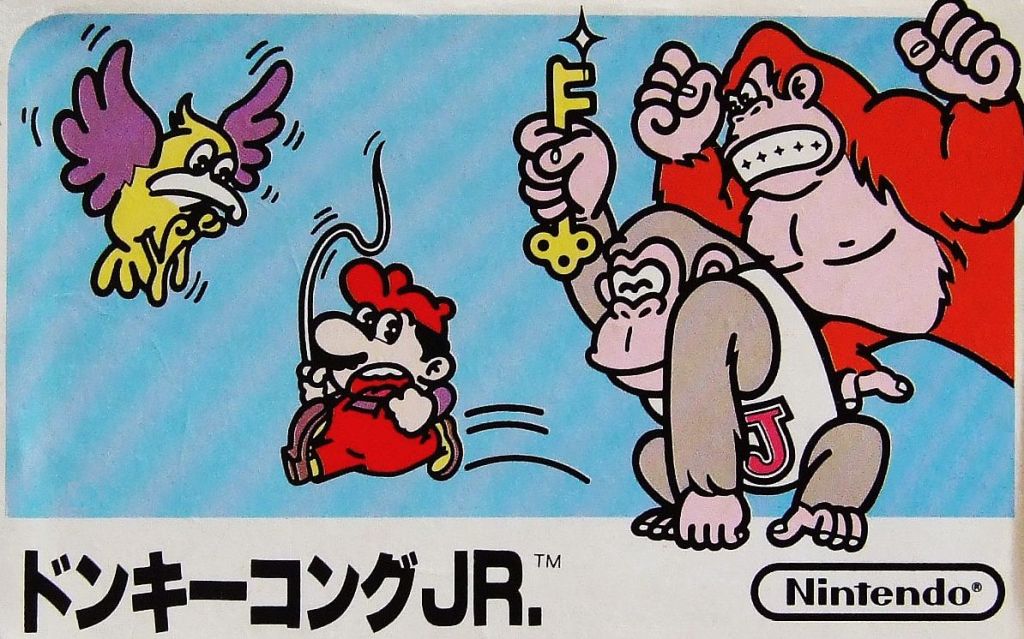
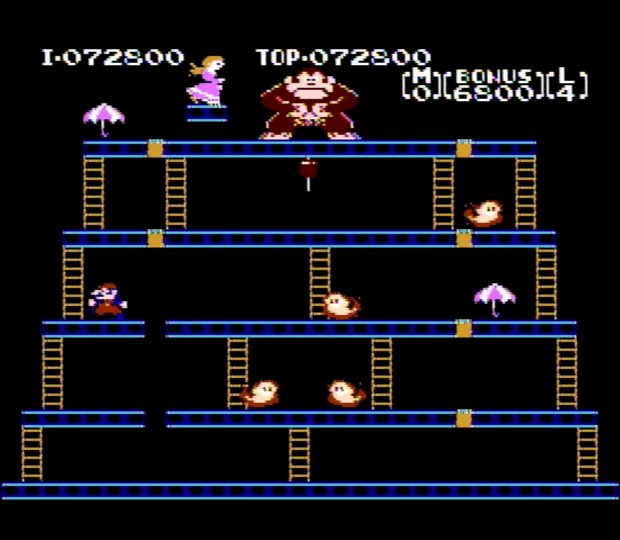
    Moving on to the second of the three launch games for the Famicom, Donkey Kong Jr. which was released on July 15, 1983. This was an arcade to home conversion of the 1982 sequel to the original Donkey Kong. Where Donkey Kong could be seen as somewhat of an old game by the time of the Famicom’s release, Donkey Kong Jr. was still relatively fresh. But does that mean that it is the better game of the two? Well, let us find out.

    First of all, you will notice that you no longer control Jumpman. Instead he has become the villain that put Donkey Kong in a cage! You now play Donkey Kong’s son and have to rescue your dad. Just imagine this wild and drastic change! Mario as the villain would be unthinkable today! But back then it was not a franchise, yet, so they could do whatever they wanted with it. This role reversal is pretty interesting, both in terms of story and gameplay. Because the previous game focused on jumping and on actions that a human could reasonably do. But now the game is all about an ape and his “move set”, so to speak. As such the game is centered around climbing. While Jr. can still do some jumping, most of the levels revolve around climbing. I think that this is emblematic of a certain approach to game design, that Nintendo would later be known for, i.e. revolving a game around a certain gameplay style, and then designing everything around it second.

    Either way, Donkey Kong Jr. plays surprisingly well on the Famicom. Climbing the vines feels much smoother than climbing ladders in the predecessor. There is no longer this awkward stiffness instead it just feels great to play! Jr. can cling to one vine or two. If he is clinging to one vine climbing becomes more difficult, but descending is done very quickly. However, if he is using two vines he can climb very fast, but descend rather slowly. This creates a very nice contrast, and a little bit of complexity. After all, if Jr. is climbing on two vines he becomes an easier target, but he can also switch easily between the left or right vine to avoid enemies coming from above or below. The levels make frequent use of Jr.’s climbing skills, and he is overall adequately equipped to deal with the challenges. Though this does not mean that it will be easy to save his father.

    The game has four levels overall which come one after another in sequential order, whereas the arcade version has a similar format to Donkey Kong arcade where the first (difficulty) level/loop only has two stages, the second level three stages and so on. I think that the Famicom version does improve upon this formular by giving you all four levels one after another without this multiple loop gimmick of the arcade game. This ensures that even a mediocre player like myself can experience every single level without having to practice for many hours until I make it through the third level/loop.
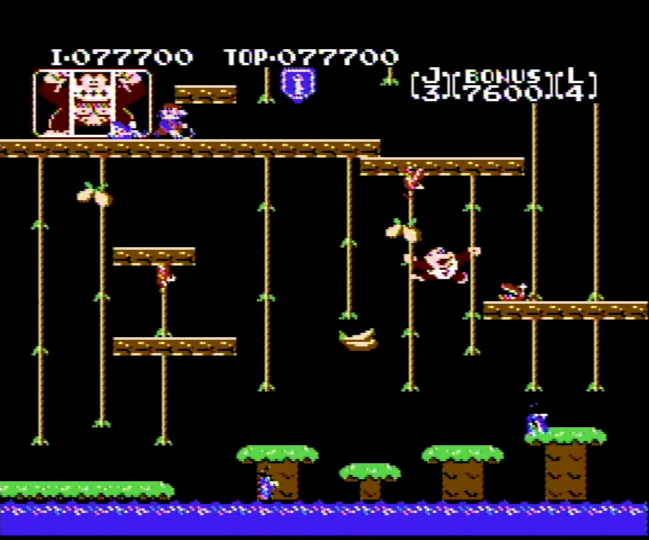
    In the first stage Jr. has to climb a bunch of vines and make it from the left of the screen to the right, then up and to the goal on the upper left. Mario tries to hinder you by releasing a bunch of blue Snapjaws that move around on the upper ledge and more or less randomly pick a vine that they fall down. Apart from these endlessly respawning enemies there are a bunch of red Snapjaws that do not disappear and constantly go up and down the vines or move along the platforms. You can kill these by dropping a fruit on them and even gain some extra points this way. This first stage is not all that difficult at the beginning, but it does get somewhat challenging later on. I have also noticed that it is much easier than the arcade version since Mario can make the red Snapjaws respawn as well, on top of there just being much more enemies on the screen at once to the point that it is easy to get trapped. However, the Famicom is a lot easier throughout and you can see it right away in the first level.
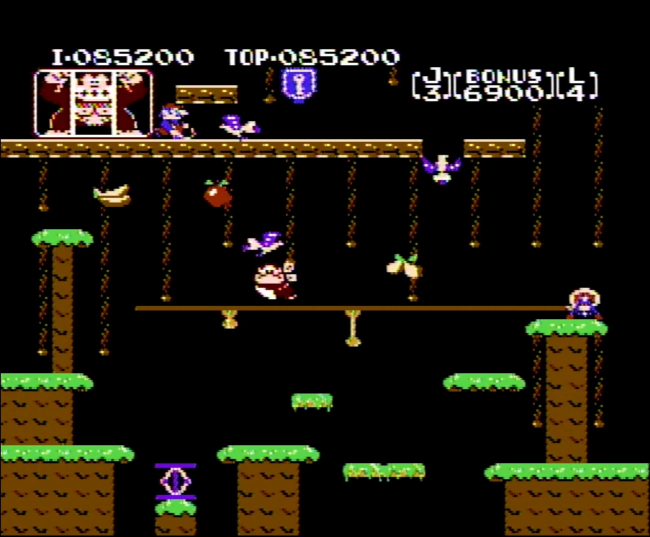
    Anyway, on to stage two. Here you have to have to go to the right, left, right and left again, but with some different obstacles this time around. There are now horizontally moving platforms, birds that can kill you while you are trying to make your way along the vines, and a spring. This time it does not kill you, but allows you to take a shortcut by jumping on one of the moving platform. But be careful! If you fall from too high up then you can die from fall damage. You also want to watch out for the birds that drop deadly eggs on you or this annoying handle on the left that sometimes retracts so that you can not hold onto it. Despite all of that this level is not too difficult on the Famicom version of this game.
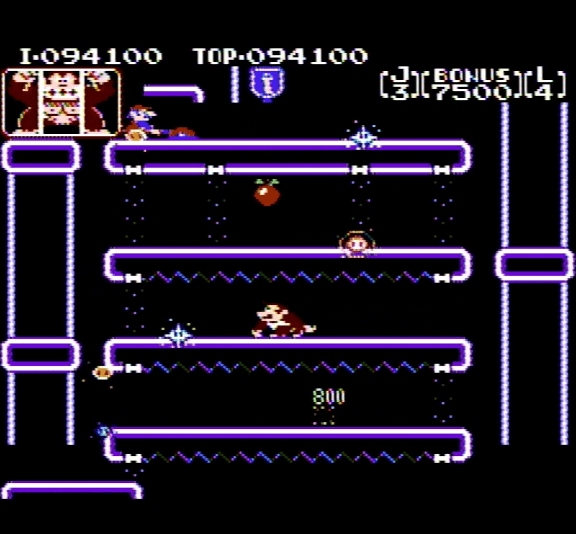
    Stage three is very different from the rest of this game. It has a futuristic theme with lots of metal and very weird sounding electronic music. This time around Mario does not send animals after you, but sparks. The blue ones drop from above and move along the metallic “vines” and the ground until they eventually disappear. Meanwhile the red ones constantly move around the platforms. Together they can pose quite a threat. You have to watch out for sparks coming towards you as well as the sparks below and above you, some of them even coming from behind. This makes the stage quite challenging as you have to keep track of everything that happens around you. You also can not jump carelessly. During early loops this stage is still quite doable, but on the higher difficulties it poses a formidable challenge.
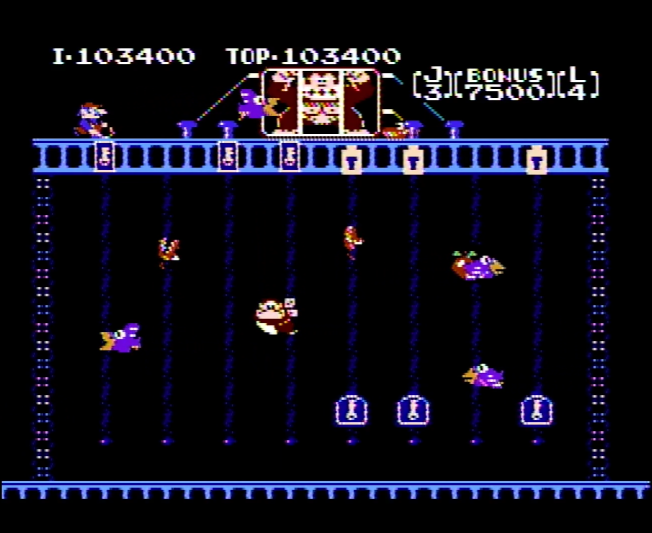
    Eventually Jr. makes it to stage four where he can finally rescue his father from Mario’s evil clutches. Here Mario and Donkey Kong are on a platform at the top with lots of metal chains hanging below it. On some of them there are weirdly looking keys that Jr. has to carry to the top thus unlocking the padlock. More so than in any previous stage Jr. has to climb a lot in this one. And by that I really mean a lot! By now you should have gotten accustomed to fast climbing with two hands and quickly sliding down on one vine/chain. Mario is now also sending two threats towards you. On the one hand are the red Snapjacks that, as you may remember, do not disappear on their own unless you kill them with a fruit. On the other hand are the birds again that respawn infinitely. They also fly back and forth this time around. Therefore you have to keep track of two types of enemy patterns at the same time while constantly getting harassed. In the arcade version this level was pure hell with something of sic to eight Snapjacks moving around as well as a constant barrage of birds. Luckily, the Famicom version just can not display so many enemies at the same time, so it becomes a lot more manageable which I personally like.

    In the end, Donkey Kong Jr. saves his father only for the entire thing to repeat over and over again until you lose all your lives. It is a typical high score chaser, but a pretty good one. It is therefore perfect for occasional play sessions or maybe even more serious and dedicated attempts for a high score. I had some good fun playing this casually and just seeing how far I could make it without getting all sweaty. I even enjoyed it a little bit more than its predecessor thanks to the additional level and the more satisfying controls. It also feels like some levels have more of specific patterns that vary depending on the difficulty instead of pure randomness like the barrel stage in Donkey Kong. As such I could find more reliable ways to make my way through certain levels.

    However, when I looked at my old notes from years ago when I “beat” it for the first time, I actually gave it a lower score than regular Donkey Kong. It made me wonder if I maybe just gave Donkey Kong a better score because it was the highly acclaimed original and I maybe I felt that I had to score it higher and like it more because of its reputation. Have you ever noticed how public opinion and the whole things surrounding a game made it seem better to you, like you are obligated to like it just because of its place in history or because everyone says you should and you feel wrong or weird for not feeling the same way? I kind of got this with these two games which to me highlights the difficulties of even trying to be objective about games, or media in general, where so much has already been said about it. As a result my following rating is just based on how I am feeling about this game right now.

    Rating: 7.5/10
    Difficulty: 2.5/10 (for the first loop, later loops would probably be closer to 5 or 6/10)
    Time to beat: ca. 5 minutes (for one loop)
    Beaten? – Yes. Multiple loops, but no maxed out score or kill screen.
    Ranking: #1 (of 2)

    Next time we will look at the final launch game for the Famicom: Popeye. Stay tuned for that!

  • Posted on October 9, 2025

    It’s been a while since I last made a post. My mistake was to spend too much time on researching gaming history and diving into all the facts or trying to verify specific information, like looking up the sources etc. This ate up so much time that I ended up doing more research than actually playing games or writing about them. So, I’ve decided to simplify stuff and not go on about the individual game’s history and whatnot. Instead I want to focus more on the game itself and whether it’s still fun to play. So with that in mind, let’s look at the Famicom version of Donkey Kong.

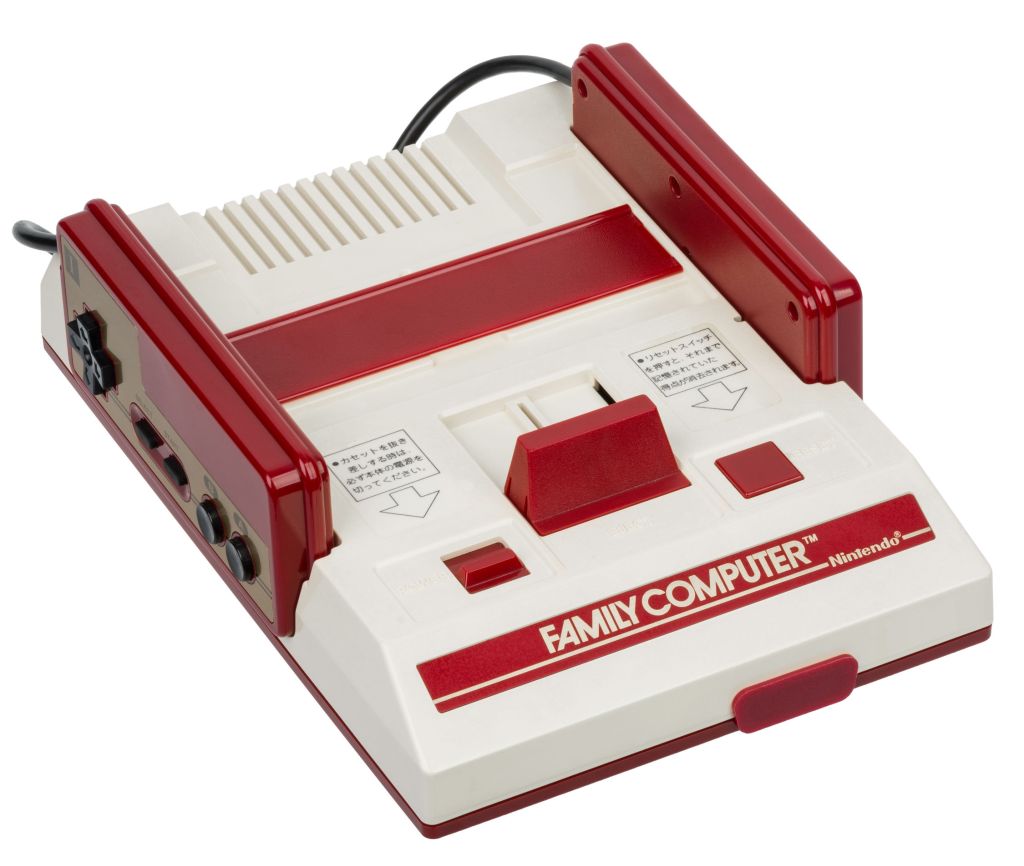
    This game was one of the three launch games that arrived with the Famicom in Japan on July 15, 1983. As is often said, the Family Computer, or Famicom for short, was designed around providing a decent home conversion of this classic arcade game from 1981. And if we compare this game to the version available on the Atari 2600 or the Colecovision, then this version does stand supreme. It looks close enough to the arcade version and the controls are also pretty accurate. However, this version misses one of the four original levels, i.e. the pie factory, which is a shame.

    Anyway, in Donkey Kong you play as Jumpman, before he became renamed as Mario, the famous Italian plumber we all know and love. But back then he was a total unknown and just a new video game character trying to save his girlfriend from a stubborn gorilla who had previously kidnapped her, and carried her on top of some construction site. So as you’re making your way up the girders going from left to right, climbing stairs, and going right to left again and so on, good old Kong is throwing barrels down along the girders. There’s even some kind of sentient flame popping out of a flaming barrel that follows you. This and the time limit are obviously meant to force the player to move forward instead of taking their sweet time. After all, the arcade machines had to make money. Either way, Jumpman has to avoid all of these obstacles without any regular means of fighting back except for the fixed amount of power-ups per level. These would give you the means to fight back for a limited amount of time, almost like in Pac-man. However, the barrels and the flames respawn indefinitely and you can’t climb the ladders while still having the hammer power-up. It also doesn’t make you absolutely invincible since objects can still hit you if you’re not careful! This happened to me a bunch of times until I adjusted to it. On the one hand this can be a little bit frustrating, on the other hand it makes the game a bit more challenging and interesting, if you’re not 100% invincible after picking up a power-up. It comes with its own downsides and makes for a more interesting challenge.

    There’s also a lot more depth to even just the initial level. There are for examples hidden mechanics that are abused by pro players for high level play. Chief among those techniques is barrel steering, where a good player can change the direction of the barrels in his favor by making them overlap one another, thus making it easier or even possible to jump over them. Basically, when you press the D-pad to the left, then barrels to the left of you have a higher chance of rolling down a ladder. The same applies to pushing the D-pad to the right and barrels that are on your right side. This way you can eliminate the threats that these barrels pose, but it doesn’t work all the time. The percentage for this to happen increases with the levels. So, while you’re still on your first loop this might barely ever occur, whereas on later loops of the game this turns into a valuable strategy. However, I’m not quite sure if this even works in the NES version of the game. I tried it while trying to clear several loops of this game, but it didn’t really seem tow ork all that well. That being said, I can understand why Donkey Kong has garnered so much attention. It’s easy to grasp and play while still offering a lot of depth for the more skilled and devoted players.

    Coming back to the game mechanics, there are two very distinct features of the control. First of all, the jumps are fixed, i.e. when you press jump you always jump the same height or distance. You can’t control the height or length of the jump by the duration of your button presses. This means that you have to commit to every single jump. A careless jump can easily cost you a life or ruin or run. Second, this game features a lot of ladders. And by that I really mean, lots of ladders! The act of climbing them, however, feels very stiff and awkward. You have to stand really close to them and be careful with pressing up and down, because I’ve had so many instances where Jumpman would just get stuck on a ladder which in turn got me killed. Sometimes he starts climbing, but then stops shortly after. Or I want to get up to the girder and jump over an incoming barrel, but he then doesn’t climb the last few inches, and I get killed. These two factors make the controls really somewhat clunky, in my opinion. It’s still playable and enjoyable, but you definitely need some time to adjust to these controls, especially if you’re used to Mario’s athleticism in modern games, or even the later NES Mario games that would soon follow. But for the early 80s this is probably as fine as it gets.

    Moving on to the second level. Whereas many games of this vintage would only have a single screen of action, Donkey Kong distinguished itself by having multiple thus offering more variety. And in this case it’s the spring level. Here Jumpman has to climb a lot more ladders, jump across rising and lowering platforms and evade the occasional flame enemy. But at least Kong doesn’t annoy you with barrels in this stage, so it should be easier, right? Not necessarily. Because the real challenge of this level starts during the final section where you have to climb up a ladder, move to the left and climb up another ladder to save Jumpman girlfriend. However, Kong is throwing springs at you which you have to avoid. This is easier said than done. Maybe on the first or second loop of the game you can still get through this section with relative ease. But in later loops the springs move so fast that you need to have the right strategy and very good reflexes to make it past them. For you see, the springs jump along in one of three patterns and two of them make it impossible to climb the final ladder. From my observation, in later loops you can only climb the ladder if the spring starts very low from the left of Kong’s right foot. If they start from any other position they will eventually jump so high will get you on the top of the ladder, no matter how fast you move and climb. This section was, and actually still is, the breaking point for me. I could never match my reaction speed to this resulting in me burning through my lives on this level, unless I got really lucky. So most of my runs end here during the fourth or fifth loop. Much respect to anyone good enough who can just keep on playing until the game glitches out and you reach the kill screen.

    After all this, we finally arrive at the third and final level of the Famicom/NES version of this game. Here we have to, again, climb up girders via ladders and destroy a bunch of joints holding the girders together while avoiding infinitely respawning flames that want to kill us. Jumpman has to walk or jump over these joints, four on the left side and four on the right, in order to finally beat Kong and rescue his girlfriend. Here it’s important to manipulate the spawning of the flame enemies as they only appear on the opposite side of the screen. Therefore, my strategy is first destroying the bottom left joint and the two at the top left, then going down to the hammer on the left side, picking it up and then moving to the right eliminating all the flames in my path. I then move to the right half of the screen to make them respawn on the left side where they are trapped now. But it doesn’t always work on later loops, because the flames spawn so early and move so quickly towards you that there’s not always time for this. You could always jump over the flames, but the move around so erratically that it never reliably works for me. The will randomly follow you, then stand around for a few second or move in the other direction. This makes jumping over them an extremely dangerous move.

    Either way, you’ll eventually beat this level and rescue Jumpman’s girlfriend only for the game to start over again, but this time with a higher difficulty. It’s typical stuff for old arcade-style games like this. After all, arcade games had to be short and easy to understand, so that people could immediately start playing while at the same time tweaking the difficulty in such a way, that the average session should only last a few minutes. After all, the arcade machine operators only earned money if people threw in quarters. But at the same time the game needed to be fun enough and offer enough game time and value so that players would return and try again. As such it’s only natural that home consoles with their limited technical capabilities would try to emulate these games instead of offering something more in-depth, like the computer gaming scene back in the day. So, for a launch game for a home console from 1983 this is a perfectly good game to start out with. It’s easy to learn, but hard to master, and offers enough variety to differentiate itself from a good chunk of the competition. It’s unfortunate that only three of the four levels could make it into the home console release, but I’m sure that it was still an enticing enough game for prospective buyers back in the day. Donkey Kong would maybe seem a bit of an old hat by the time it reached the USA in 1985, but at the original time of its console release it as fine of a game as you could hope for.

    This leaves me in a difficult position to rate this game. I have thought quite a bit about whether or not I should use a numeric scale to rate these games. But the difficulty comes from what I should base these numbers on: how good the game was for its time? How good it’s compared to the rest of the library? But if I haven’t played all 1000+ Famicom games, can I even rate it? And what about the historical significance of the game? Should that count into a potential rating system? I honestly don’t know. Donkey Kong is a contender for games that every gamer should try, but does that mean, that I’m still coming back for it in the years 2025 or beyond? I might dabble a bit in it here and there and have fun for a while, but it’s not among my favorite games on the system. As such I would probably still give it something along the lines of a 7 out of 10. Before people start picking up their pitchforks, I still believe in using the entire range of the rating system. So I might drop some 1s or 2s later on. I’ve also found some enjoyment in games that I would label a 4 or 3. Some might call this range of games enjoyable Jank and I’m here for it. Either way, Donkey Kong is currently the number 1 game in my ranking since it’s the only game I’ve ranked for this endeavor so far.

    Finally, some word about how long I’ve played this game. I’ve mastered the NES version of this game on Retroachievements and played it on and off over the past years. I also recorded a playthrough of me doing a few loops on Mode A and on Mode B, which seems to be about the same. I think you just start one loop later, i.e. loop/level 1 of Mode B probably equates to loop/level 2 of Mode A and so on. My criteria for “beating” arcade games is not playing until the score rolls over or until reaching a kill screen, if that even exists in the game, but instead I go for playing until the game starts looping and beating the pre-set high score. So in short:

    Rating: 7/10
    Difficulty: 3/10 (for the first loop, later loops would probably be closer to 7 or 8/10)
    Time to beat: ca. 5 minutes (for one loop)
    Beaten? – Yes. Multiple loops, but no maxed out score or kill screen.
    Ranking: #1 (of 1)

  • Posted on July 4, 2025

    The history of Nintendo goes all the way back to 1889 when a then 30-year-old Fusajirou Yamauchi opened a factory for handmade Hanafuda playing cards. These had seen increased demand after the gambling laws had been relaxed in 1885 by the Meiji government. However, these handmade card decks were very expensive which limited the potential customer base. To counter this, Fusajirou shifted towards selling cheap card decks to gambling parlors since they would throw away a deck after just a single use. This meant that Fusajirou could potentially sell about 50 cheap card decks to each gambling parlor. It is wildly ironic to me that the family-friendly Nintendo had initially deep ties to the gambling industry.

    For the next 70 something years, Nintendo would continue to sell various kinds of cards with which they had decent success. But eventually the market was saturated and it became evident that producing cards alone could no longer sustain Nintendo. Therefore, they started experimenting with toys around 1965. In the same year they had also hired an electronics graduate by the name of Gunpei Yokoi to maintain their assembly-line machines for Hanafuda cards. During his spare time, he had worked on an extending arm that the then president Hiroshi Yamauchi had noticed while inspecting the factory. He ordered the young mechanic to turn the extending arm into a proper product so that it could be sold for the upcoming Christmas season. This toy released in 1966 as the Ultra Hand and was a very successful release for Nintendo. It reportedly sold over a million units. If you want to learn more about the Ultra Hand and a whole slew of other Nintendo toys from this era of the company, I can recommend to you the blog Nintendo before Mario: http://blog.beforemario.com/2011/03/nintendo-ultra-hand-1966.html

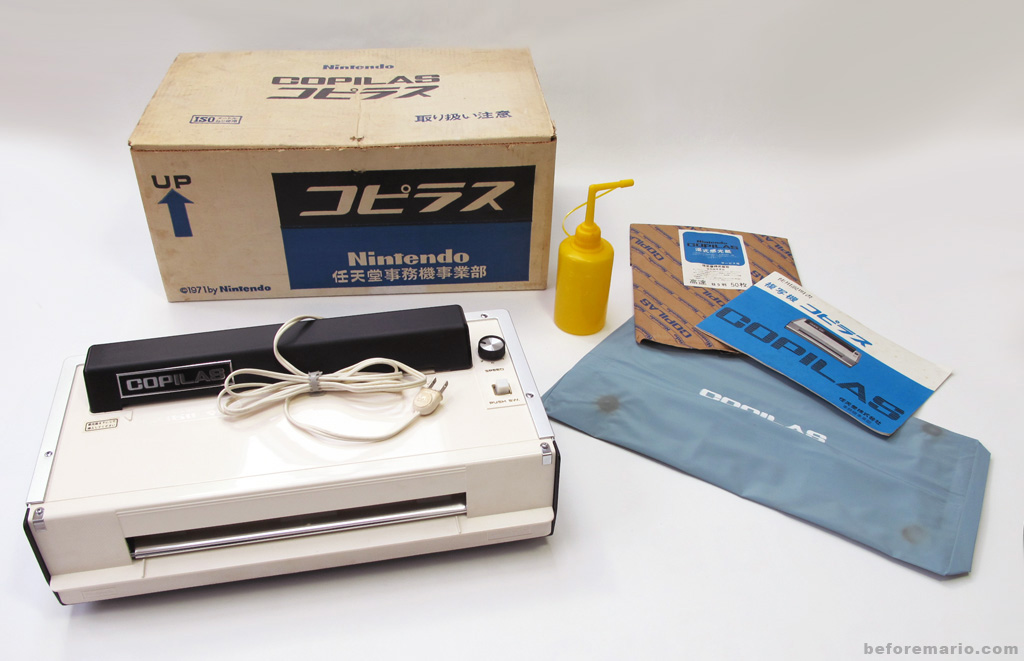
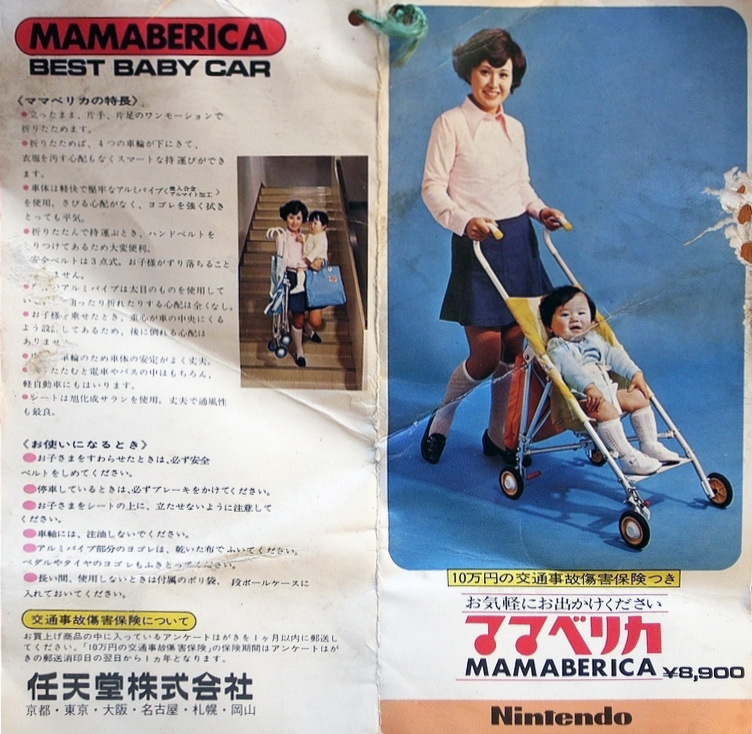
    Despite this early success, Nintendo was still struggling to find their new identity and branding as they were also releasing all sorts of other products, like a copy machine called Copilas or even a baby car going by the name of Mamaberica!

    Nintendo’s copy machine called Copilas that had released in 1971 for 9,800 Yen which would be 33,353 Yen when adjusted for inflation which amounts to $ 232 US in today’s money.
    Mamaberica sold in 1972 for 8,900 to 9,500 Yen.

    This is exemplary of the lack of focus and the lack of a unifying vision at Nintendo in the 60s and 70s. The development staff of Nintendo would each work on their own to create new products, and if it seemed like a viable product, it would get made. One emerging sector that they were eyeing was the market for pocket calculators which had just become affordable for the average consumer. However, it seemed like Nintendo arrived to late to the party. Many manufacturers had already started selling their devices, and were even competing to sell devices for less than 10,000 Yen. Nintendo did not think that they could compete in this market and backed out. But a pocket calculator would later play an essential role for developing the Game & Watch line (1980 and beyond), when Gunpei Yokoi was riding a Shinkansen where he saw a bored businessman playing with an LCD calculator. This gave him the inspiration for portable gaming devices.

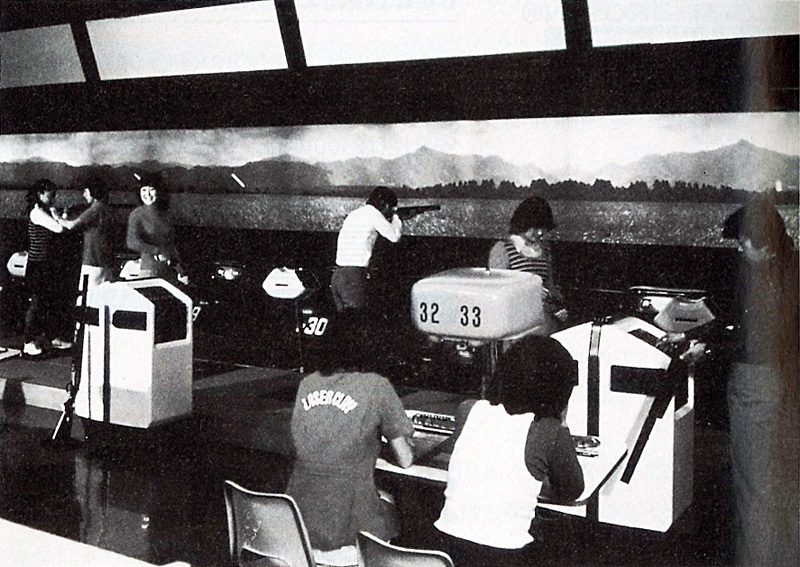
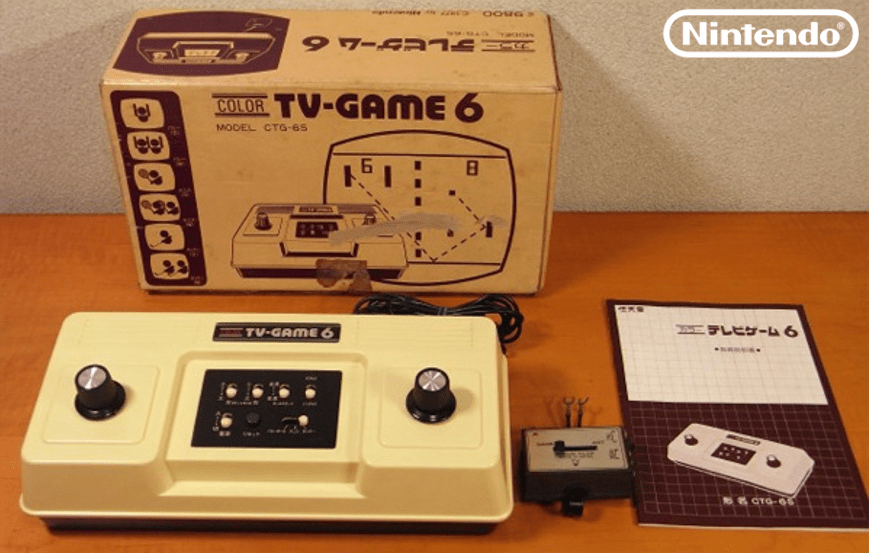
    Going back to the 70s. Nintendo was expanding its portfolio by also producing arcade devices, like the Laser Clay Shooting System from 1973. Nintendo had partnered up with Mitsubishi Electronics for this device who then afterwards approached Nintendo saying that they had LSIs suitable for TV game machine that could display color, and they were asking if Nintendo wanted to turn them into commercial product. Masayuki Uemura was interesting in developing such a device since no color TV game had been on the Japanese market at that time. This eventually led to the development of the Color TV-Game 6, which was launched on June 1, 1977 for 9,800 Yen, and the Color TV-Game 15 which released only a week later and retailed for 15,000 Yen.

    The Laser Clay Shooting System (1973) was developed with the help of Mitsubishi Electronics. Sadly, the oil crisis of 1973 caused a recession in Japan, so most orders were cancelled throwing Nintendo into severe debts. In the following year Yamauchi ordered the release of a miniaturized system called the Mini Laser Clay which became quite the success and eventually led to the development of a similar shooting game by the name of Duck Hunt in 1976.
    Nintendo’s first home console: the Color TV-Game 6. It was a Pong clone console for which Nintendo had acquired a license from Magnavox to avoid getting sued like Atari and other Pong console manufacturers. Hiroshi Yamauchi reportedly only let Masayuki Uemura develop this product, if he could offer it for a price lower than 10,000 Yen. But this was hardly possible, so Uemura suggested a crafty scheme to still earn a profit. They would sell two devices, that were internally identical, but one of them had only 6 of the 15 games enabled, and it would be sold at a low price of 9,800 Yen. Meanwhile the device with all 15 games enabled would be sold a week later at 15,000 Yen. This way Yamauchi could tout their new device being cheaper than all competing products, and get good publicity, while also backing down and eventually selling the more expensive product.

    In the following year Nintendo released the Color TV-Game Racing 112 and the year after that (1979) Block Kuzushi, which was a dedicated Breakout console. Nintendo used their cooperation with Mitsubishi Electronics to send some of their staff there so that they could learn how to build breadboards themselves. The first Color TV-Game was still based on already pre-designed LSIs, but with their third game, Block Kuzushi, they managed to create the Breadboard all by themselves for the first time, even if they had to still bring the final circuit diagram to Mitsubishi Electronics to have them check it. Now that they have learned the ropes, they wanted to continue to design consoles dedicated to single arcade games and designed with their specialized LSIs. However, with the arrival of Space Invaders later in 1979 the era of game devices with specialized LSIs came to an end as they were replaced by micro processors. This is also the reason why the Computer TV-Game (1980), a dedicated device for playing Othello, was the final release in this product line. In the future they would eventually build a device that could play different games by switching cartridges instead of buying a completely new console, the Family Computer.

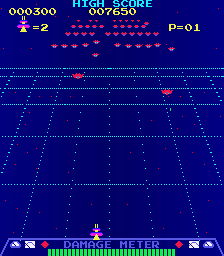
    But before that Nintendo had still some ways to go. Around 1980 they had their Research & Development No.1 Department work on portable gaming devices in form of the Game & Watch, while the R&D2 Department switched their focus towards arcade games. One of their games was 1979’s Space Fever which was a blatant Space Invaders rip-off with only some minor alterations. In 1980 they followed up with Radar Scope that was inspired by Namco’s Galaxian which itself was an evolution of Space Invaders. The new technological advancement of Galaxian was that it was the first game that used tile-based hardware allowing for sprites to be displayed and for the background to be scrolled. Nintendo’s Uemura was shocked when he saw the new technology: many characters could be displayed and they were able to move around quickly. On top of that, the background moved creating the illusion of stars moving in the distance. It is not difficult to see the similarities to Radar Scope, which showed more originality instead of ripping off another game almost one-to-one. But despite that, Radar Scope sold poorly and Nintendo was sitting on roughly 2,000 unsold arcade machines in their warehouse. As is famously known, the hardware for this game would be repurposed into Donkey Kong (1981), Nintendo’s first international smash hit.

    Without the failure of Radar Scope we might not have gotten Donkey Kong.

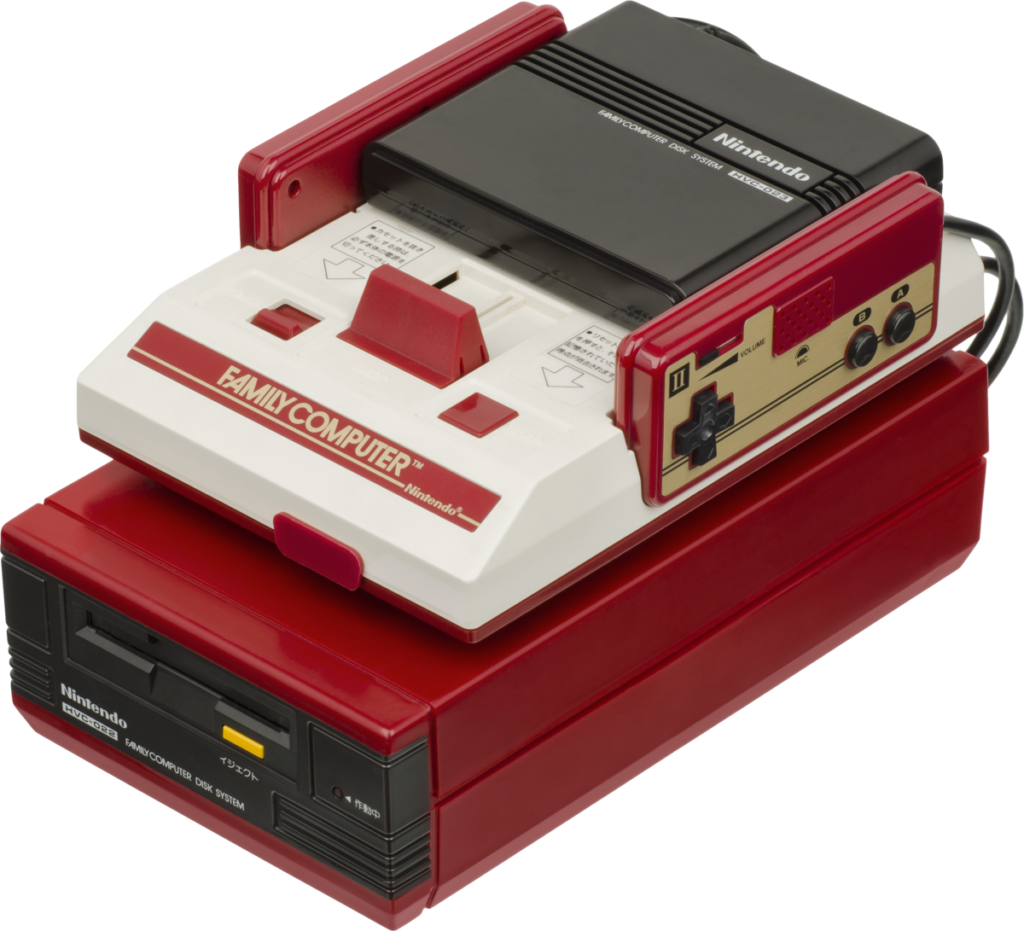
    In October of 1981 Nintendo’s president Hiroshi Yamauchi approached Nakagawa and asked him to create a game device for use at home. Uemura gathered the remaining engineers from R&D2 Department and got to work. The console would be developed under the codename GAMECOM and was inspired by the ColecoVision. This was due to an employee of Coleco visiting Nintendo and showing off their console. The engineers of R&D2 were impressed by the smooth movements and one of them, Takao Sawano had even taken the console home to show it to his parents who were amazed by the technology. Therefore, the Famicom was not developed with the Atari 2600 in mind, but the ColecoVision! Sawano also proved to be crucial to the success of the console in some other unexpected way. He started off working at R&D2, but got transferred to R&D1 to help with the Game & Watch devices. While working on the Game & Watches he saw that they had invented a directional pad, i.e. the D-pad, for moving the game’s character around. He would take this idea with him and suggest it for Nintendo’s new home console.

    The actual development of the device started as late as June 1982, and for the first three months they did not even have a concrete idea of what the finished product should be like. Instead, Uemura sent two member of his team, Katsuya Nakagawa and Masahiro Ōtake to the semiconductor manufacturer Ricoh to come up with the specifications. All they had to work with was one of their arcade machines with Donkey Kong. They wanted their device to be more powerful than the Atari 2600 and the ColecoVision as they wished for a more arcade-like experience.

    Initially, the Nintendo engineers wanted a Z80 for their home console since they were used to developing for it from their arcade machines. But their contacts at Ricoh recommended them the 6502, because they had the rights to it from Rockwell, but also because it was smaller and thus cheaper. Furthermore, it was much smaller than the Z80 and required about one fourth of the space, so that Nintendo could use that space for their own custom chips. The 6502 was also fairly uncommon in Japan, so other companies would take longer to copy it. For these reasons Uemura decided to go with the 6502 instead of the Z80.

    However, there was one big problem with the new chip: Nintendo’s developers did not have the proper development tools and did not know how to work with this chip. Therefore, development of the games, which started in late 1982, took longer than expected. Their problems would be solved by a new hire in April 1983. Shuuhei Katou was in a micro computer club at his university where he became very familiar with the 6502. He learned programming with on old arcade board, that had a 6502 equipped. So, when he arrived at Nintendo, he was not a newbie who had to be coached and taught. Instead, he showed everyone else how to operate the 6502, and basically became their “living manual”. Thanks to him the game development progressed much faster.

    There is still more to discuss, and more interesting tidbits to share, but I will do this another time, because this article has already become much longer than I had anticipated. I will also return to just talking about video games pretty soon, since I have recently spent a lot fo time with many different versions of Donkey Kong. So, look forward to that as well!

  • Posted on June 26, 2025

    In the past few years, I have spent a lot of time playing and beating various games on the NES. The reason for that was me stumbling upon Nintendo Age during its final days and participating in the yearly NES challenge thread as well as the weekly NES competitions. I continued these after their move to Videogamesages and went absolutely wild in some of those years. The combination of playing NES games, that were completely new to me, and the competitive aspect really appealed to me. Over the years I have beaten over 200 NES and Famicom games for the first time and was happy with how deep I delved into that system’s library even though I have barely ever played NES games before.

    My first exposure to the NES was in the late 90s at a friend’s house after we had exhausted every single game we had on the SNES, N64 and PC. That is why he dug out his old NES and the three games that he had. Those were Super Mario Bros., The Legend of Zelda and some kind of soccer game. I was not interested in Super Mario Bros. on the NES because I had already played enough SMB games on the All-Stars collection on the SNES. The soccer game was mildly fun, but not due to its captivating and realistic gameplay. No. We had much more fun fouling the played from the other team and getting them off the playing field. We tried to get rid of every other player except for the goalkeeper. It never quite worked out, but it still made for a nice little time waster.

    As for The Legend of Zelda, you might be surprised to hear that I initially really hated this game. My only exposure up to this point was A Link to the Past, Link’s Awakening and Ocarina of Time. So, imagine going from these absolutely amazing games to the very first entry in the series. Holy smokes! The difference was night and day! It felt so clunky and was difficult, too. We did not have the manual and did not think of looking up tips on the internet, so we tried to beat it all by ourselves. I do not know if we ever managed to do that, but I remember not enjoying the process at all. Usually, we would switch controllers and each play for a little. However, with this game I did not want to play myself. I mostly sat beside him and tried to come up with ideas on how to progress.

    After this I never really played the NES for the next 15+ years or so. Over the coming years I would still go back to play SNES games or Super Famicom games with fan translations or the occasional PS1 RPG that missed out on. But I never really went back to the NES again until the NES Classic Mini came out in 2016. By that time, I was already getting into retro gaming and wanting to learn more about gaming history, including the truly old stuff like the Atari 2600 or the Philips Videopac 7000, a.k.a. the Odyssey II in North America. But the NES held a special position, because it was still old-school, while at the same time being more sophisticated and interesting than the Gen II consoles. Either way, I only played some games randomly on the NES Classic Mini, but eventually stopped. That is, until I stumbled upon the aforementioned NintendoAge.

    Before I didn’t have the patience for most of those old games, but when I tried them during that time, I did not mind the quirks of these games as much which seemed quite weird to me. The jump back from the SNES/N64 to the NES was more jarring to me than going back from the PS3/Wii U to the NES. Or maybe it way my age and that I became more patient. Most people seem to be performing worse at these retro games the older they get, but for me it was somehow the opposite. Patience and pattern recognition really pay off in these old-school games.

    Anyway, since I had already been playing so many NES games over the past few years I had wanted to maybe try and beat every single game released in North America, like the Mexican Runner and Kelsy Polnik. Unfortunately, many NES games are brutally difficult and probably impossible for me to beat legitimately. That was when I came up with the idea for this quest. It combines the challenge of beating an entire console’s library while also giving it a slightly different spin. After all, the US NES library has already been beaten multiple times and discussed to death. But by focusing on the Japanese library, I might be able to offer some new insights. I also speak Japanese, so the language barrier is not really an obstacle for me, which allows me to play text-heavy games that haven’t been translated yet. That being said, I will not require every game to be beaten “legitimately”. I just want to experience these games and get an understanding of them without having to spend months or years on certain overly difficult and frustrating games. Of course, I will always mention if a game was beaten legitimately or with help. See more for the rules section.

    Rules of the Challenge

    Beating a game, playing through a game, finishing a game, seeing a game until the end, or completing a game …
    These are all similar terms, but they carry different associations with them. Especially with such old games the definition of beating a game or winning at a game can get very muddy. Kelsy Polnik did a very nice and comprehensive video about all the nuances that go into defining a win condition. You can see the full video here:

    It should be obvious that defining a win condition is really complicated with this many games. There will be times when it becomes hard to tell what counts as beaten. As such my goal is not to beat or complete every single game without any help. Instead, I want to play and experience the games for so long that I can form an opinion on them. I will still try to “beat” them, but I leave the option for me to use save states or similar help to see more of the game. If I use any help like this, I will notate it! I might also return to a game later during the journey. So even I did not clear it at the time of writing the blog entry for it, I might return to it and finish it later legitimately. For the more concrete win conditions I will borrow from Videogamesages since these seem to be the most reasonable:

    • A game only counts as truly beaten, if it was done legit, i.e. without save states, fast forwarding, rewinding, cheats etc.
    • Emulators and Everdrives are allowed if the above functions are not being used
    • No turbo controllers or other peripherals that offer an advantage.
    • Continues, passwords and codes are allowed, if, and only if, the game or the manual provides them. The Konami code or the ABBA code in Ikari Warriors therefore are not allowed, even if they are widely known because they are not something that the game provides to you on its own, but requires external knowledge instead.
    • Games with no ending that loop endlessly are considered to be beaten if the high score is surpassed and if the game just repeats without any new content.
    • The best ending is not required, but a bad ending should be avoided.
    • However, if some content of a game is locked behind a higher difficulty or certain conditions, then that difficulty must be beaten or the conditions be met, e.g. Double Dragon 2 and Isolated Warrior.

    As you can see there are a lot of stipulations for what constitutes beating a game. These also make certain games unreasonably difficult which is why I will not necessarily beat every single game legitimately, but I will try regardless and I might return to certain games. Either way it should still be possible to review these games and maybe rank them. I will try to do that as I go. If you have read until here, you have my dearest thanks. If you have some suggestions, feel free to leave me a comment. I hope that this will be fun and that I can find some hidden gems among the Famicom library.

    Pochita is also looking forward to playing some Famicom games. Goob boy!